The exponential growth of USDT: from $1 million to $185 billion
In short: The digital dollar has grown along a near-perfect exponential curve. USDT's supply went from $1 million in 2016 to over $185 billion a decade later — more than a hundred-thousand-fold increase. In 2025 alone, stablecoins settled around $33 trillion of value, more than Visa and Mastercard combined. If you stopped paying attention a few years ago, you didn't miss a trend. You missed several orders of magnitude.
Most people's mental image of the digital dollar is frozen at whatever moment they last looked. For many busy finance professionals, that was three to five years ago. The problem is that in a market growing exponentially, three to five years is the difference between a curiosity and critical infrastructure.
So let me show you the actual numbers. They tell the story better than any argument.
The milestone ladder
Tether launched USDT in 2014. Here is how its supply — the total amount of digital dollars in circulation — climbed, step by step:
- 2016: $1 million
- Early 2017: $10 million
- Mid 2017: $100 million
- End 2017: $1 billion
- 2020: $10 billion
- 2021: $50 billion
- 2024: over $100 billion
- 2025: more than $185 billion
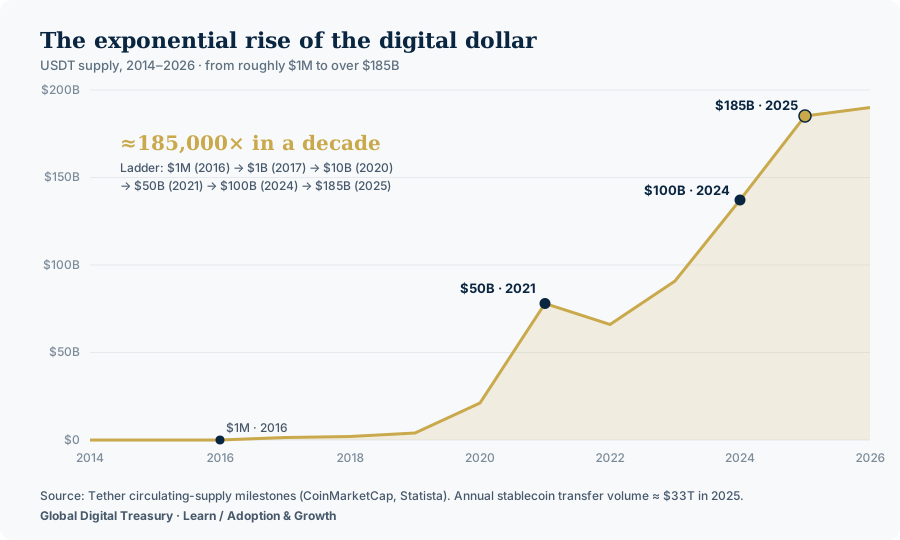
Read that ladder again. Each rung is roughly ten times the one before. That is the literal definition of exponential growth — not "fast," but multiplying. More than a hundred-thousand-fold increase in under a decade, and the curve is still bending upward.
It is not just one token
In 2018, Circle launched USDC, the regulation-first digital dollar, adding an institutional engine alongside USDT's emerging-market dominance. Today those two stablecoins together make up around 93% of the entire market, and total stablecoin supply sits north of $300 billion.
But supply is only half the picture. The more striking number is flow — how much value actually moves across these rails. In 2025, stablecoins settled in the region of $33 trillion of transfers, with USDT alone accounting for roughly $13 trillion of it. To put that in perspective, that total is larger than the annual payment volume of Visa and Mastercard combined. The digital dollar is no longer a niche settlement tool. By volume, it is one of the largest payment systems on earth.
Why it grew this way
Exponential curves always have a reason. This one had two phases.
Phase one — necessity. The early growth came from the places this site keeps returning to: emerging markets where dollars are scarce, banks are slow, and a digital dollar that holds its value and moves in minutes is not a convenience but a lifeline. Nigeria, Argentina, Turkey, and dozens of others drove adoption from the ground up, out of need.
Phase two — legitimacy. The more recent acceleration is institutional. Regulation arrived — the GENIUS Act in the United States, frameworks in the UAE, Singapore, Hong Kong and beyond. The largest payment networks moved in: Stripe acquiring Bridge, Mastercard acquiring BVNK, Visa settling billions in stablecoins. Once the rules became clear and the giants committed, the conservative institutional money that had waited on the sidelines began to flow.
Necessity built the base. Legitimacy is building the next leg.
Why this matters for you
The practical lesson of an exponential curve is about timing and perception. Early on, the numbers are small and easy to dismiss — a few million dollars, a fringe experiment. By the time the numbers are impossible to ignore, the people who understood the curve early have already built their positions.
We are now well past the inflection point. A thousand-fold growth has already happened. The question is no longer whether the digital dollar becomes part of how global value moves — that has been answered by the $33 trillion that moved across it last year. The only question left is how quickly the rest of the system adapts to it, and who is positioned when it does.
That is the entire reason this company exists, and the entire reason this education hub does too. The curve is real. The data is public. The only variable is how early you choose to understand it.
The one-line version to remember: the digital dollar grew from $1 million to over $185 billion in a decade and now settles tens of trillions a year — this is no longer an emerging trend, it is established infrastructure, and the only thing still in question is the speed of everyone else's response.