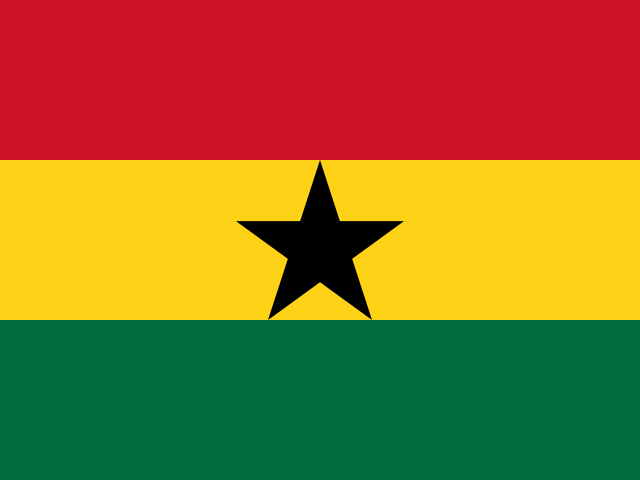
Ghana: the cedi's collapse, and one of the fastest stablecoin shifts in Africa
Ghana is West Africa's other great currency story. Nigeria gets most of the attention, but Ghana has lived through a financial shock just as instructive, and its response has been just as telling. A few years ago the cedi was among the worst-performing currencies in the world. Today Ghana has one of the highest rates of stablecoin adoption on the continent. The line between those two facts is direct, and it is the line this entire series traces.
The collapse
Ghana's troubles came to a head with a sovereign debt crisis that forced the country into a restructuring and an IMF programme. The cedi fell hard, inflation surged, and the value people held in their bank accounts and wallets shrank in real terms month after month. For households, savings were eroding. For businesses, the dollars needed to import goods and pay foreign suppliers became scarce and expensive.
That is the precise set of conditions — currency depreciation, dollar scarcity, inflation eating savings — under which dollar stablecoins move from the margins to the mainstream. And in Ghana they did exactly that.
The shift
Ghana now sits among the largest stablecoin markets in Africa, with adoption rates among digital-asset users that rank near the top of the continent and place it just behind giants like Nigeria and South Africa by value received. The drivers are the familiar ones: preserving savings in a stable dollar instead of a falling cedi, receiving remittances more cheaply than the traditional channels allow, and settling cross-border trade without the friction of the formal system.
What distinguishes Ghana is the speed of the move and the official response to it. Rather than reaching for a ban, Ghana chose to regulate. In 2025 it passed sweeping legislation to bring digital assets under a formal framework, with its central bank building the supervisory structure around it. That is the same mature posture I have praised in Kenya and South Africa — a recognition that adoption is already real, and that the responsible path is to supervise it.
The continental dimension
Ghana has also placed itself at the centre of something larger. In late 2025, a settlement initiative tied to the African Continental Free Trade Area began piloting blockchain-based payments in dollar stablecoins, with Ghana and Kenya as the first testing grounds. That is significant. It signals that stablecoin settlement in Africa is no longer only a grassroots, country-by-country phenomenon — it is being tested as continental infrastructure, and Ghana is at the front of the queue.
My read
Ghana is the West African counterpart to Nigeria, with one important difference in tone: where Nigeria's central bank is still visibly pulling in two directions, Ghana has moved more decisively toward a regulated framework. The combination is compelling — a population that adopted dollar stablecoins out of genuine currency distress, and a state that has chosen to legislate rather than resist.
Add the continental settlement pilots, and Ghana looks less like a single national market and more like a hub in a regional network taking shape. For a business building regulated corridors across Africa, that is exactly the kind of market to take seriously: real demand, a maturing rulebook, and a seat at the centre of where African settlement is heading next.
Corridor profiles are market analysis. They describe where cross-border value moves and why — not where Global Digital Treasury provides services. Servable coverage is confirmed corridor by corridor at the point of engagement, and is narrower than the set of markets analysed here.