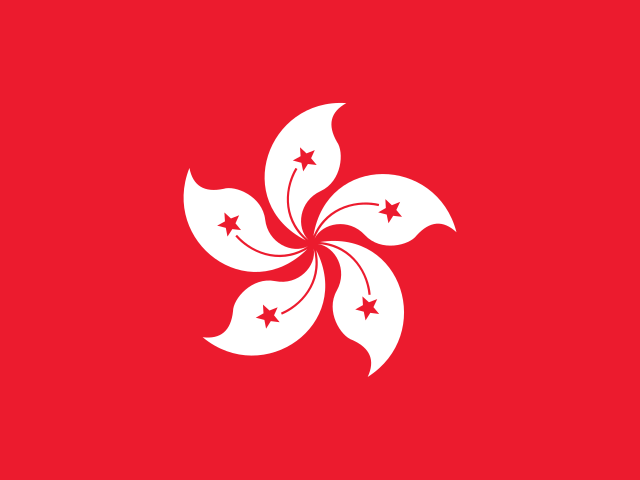
Hong Kong: the most institutional stablecoin regime in Asia — and a deliberate gateway between China and global finance
Hong Kong is the mirror image of mainland China. Where Beijing prohibits, Hong Kong regulates — carefully, conservatively, and at the highest institutional standard in Asia. It has built one of the most demanding stablecoin licensing regimes in the world, and the first licences have gone not to startups but to HSBC and a venture backed by Standard Chartered. For anyone trying to understand what the regulated, institutional future of stablecoins looks like, Hong Kong is the clearest preview available.
Orientation: one country, two systems
Hong Kong is a special administrative region of China, but it operates its own legal, monetary, and financial system, with its own currency, the Hong Kong dollar, and its own regulators. That distinction is the whole point. While mainland China bans digital-asset trading and treats stablecoins as a threat to capital controls, Hong Kong has been permitted to do the opposite — to become a controlled, regulated laboratory for digital finance, and a bridge between Chinese capital and the global system.
The Stablecoins Ordinance
On 1 August 2025, Hong Kong's Stablecoins Ordinance came into force, creating a comprehensive licensing regime for issuers of fiat-referenced stablecoins — that is, stablecoins designed to hold a stable value against a traditional currency, the category that includes USDT and USDC. The regime is administered by the Hong Kong Monetary Authority, the HKMA, which functions as the territory's central bank.
The standards are deliberately high. A licensed issuer must hold 100 percent of its outstanding stablecoins in high-quality reserve assets at all times, meet minimum capital requirements, maintain robust redemption rights so holders can always convert back to currency, and satisfy strict governance and compliance obligations. Anyone wishing to issue a Hong Kong dollar-referenced stablecoin, even from outside Hong Kong, falls under the regime.
This is not a light-touch, grow-first framework like some of the emerging-market regimes I have described. It is a bank-grade regulatory regime, and it was designed that way on purpose.
Who actually got licensed
The clearest signal of Hong Kong's intent is who received the first licences. The HKMA received applications from 36 entities, and in April 2026 it granted the first two licences — to HSBC, one of the largest banks in the world, and to Anchorpoint, a joint venture backed by Standard Chartered, the telecommunications group HKT, and Animoca Brands. Both plan to launch their stablecoin products in the second half of 2026.
Read that carefully. The first regulated stablecoin issuers in Hong Kong are not digital-asset-native firms. They are global systemically important banks and blue-chip consortia. And the HKMA has been explicit that the licensing threshold will stay high and the total number of licences will remain very limited. Hong Kong is not democratising stablecoin issuance. It is institutionalising it.
Why Hong Kong is doing this
The strategy is geopolitically shrewd. Mainland China cannot embrace dollar stablecoins without undermining its own capital controls and the digital yuan. But it can allow Hong Kong — legally separate, globally trusted, and home to the largest pool of offshore renminbi — to build the regulated infrastructure that lets Chinese and Asian capital interact with the global stablecoin economy on controlled terms. Hong Kong becomes the pressure valve and the gateway: the place where the world's most consequential trading nation touches the stablecoin system without doing so directly.
For the rest of us, Hong Kong matters as the proof that stablecoins and serious, conservative banking regulation are not opposites. The same instrument that moves value peer-to-peer in Lagos or Buenos Aires can also sit inside an HSBC-issued, HKMA-licensed, fully reserved product. Hong Kong is building the top end of the market.
What it means for treasury infrastructure
Hong Kong is less a market to be served and more a model and an ecosystem to understand. It demonstrates the regulated end-state that this entire industry is moving toward: licensed issuers, full reserves, real redemption rights, bank-grade compliance. The cross-border opportunity it creates is as a hub — a trusted, well-regulated point through which Asian and Chinese-linked trade and treasury flows can connect to the global stablecoin and settlement system.
It also sets a useful benchmark. When a treasury-infrastructure business talks about being compliance-first and institutional, Hong Kong is the standard that phrase should be measured against. The operators who will endure are those building toward Hong Kong's level of rigour, not away from it.
My read
Hong Kong is the most reassuring market in this series for anyone who believes, as I do, that the durable version of this industry is the regulated, institutional one. It shows that the largest banks in the world are willing to issue stablecoins when the rules are clear and demanding — and that a major financial centre will build those rules deliberately, as a matter of strategy.
For our work, Hong Kong is the high-water mark of credibility and the gateway for one of the most important trade regions on earth. It is not a frontier opportunity like the others. It is the institutional anchor that makes the whole thesis respectable — the proof that the future of stablecoin settlement is not a workaround at the edge of finance, but infrastructure being built at its centre.
Corridor profiles are market analysis. They describe where cross-border value moves and why — not where Global Digital Treasury provides services. Servable coverage is confirmed corridor by corridor at the point of engagement, and is narrower than the set of markets analysed here.