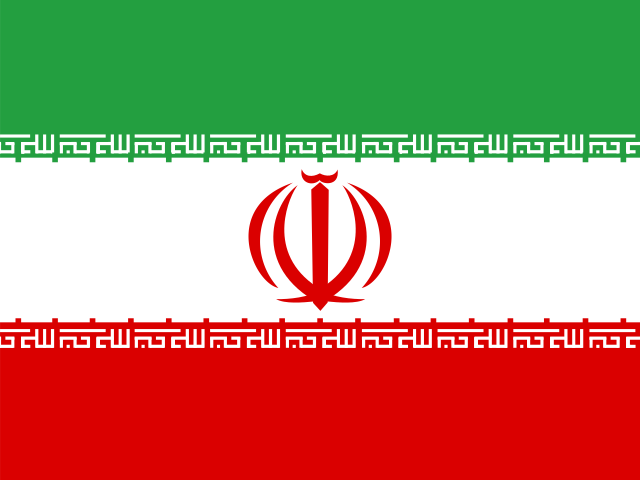
Iran: the second line a compliant business must never cross
Earlier in this series I wrote about Russia as the clearest case of a market that demonstrates the thesis perfectly and must, for exactly that reason, be refused without hesitation. Iran is the other. There are only two such countries in this entire series, and I have written both deliberately, because the boundary of the legitimate market is defined as sharply by what we refuse as by what we serve.
Iran, like Russia, confirms the argument and then places itself entirely outside the line a regulated business can operate within.
What happened
Iran has lived under comprehensive United States sanctions for years, with much of the rest of the Western financial system layered on top. It is, in the language of this series, not a country suffering ordinary dollar scarcity — it is a country whose access to dollars and to the formal cross-border banking system has been deliberately and almost completely severed by international action.
Faced with that, Iran turned to digital assets at the level of the state. It has used stablecoins and other digital assets to move value across borders outside the banking system, devoted significant subsidised energy to mining, and explored its own digital-currency initiatives — all with the explicit, openly acknowledged purpose of working around the sanctions imposed on it. In mechanical terms, this is the thesis of the series taken to its limit, exactly as Russia was: cut a state off from formal rails entirely, and value migrates onto stablecoins.
Why this is absolute, not a grey area
Here is the distinction that matters, and it is the same one I drew for Russia. Every legitimate market in this series is a USD-scarce economy seeking efficiency inside the rules. Iran is a comprehensively sanctioned state whose use of stablecoins is, by its own account, a means of evading those sanctions. That is not a compliance grey zone to be managed with careful structuring. It is precisely the conduct that international authorities exist to stop.
For a regulated treasury-infrastructure business, the consequence is not a matter of risk appetite. To touch Iranian sanctioned flows — directly or indirectly, as a counterparty, intermediary, or service provider — is to expose the business to secondary sanctions, the immediate loss of banking relationships, the loss of every licence and partner relationship it depends on, and the permanent destruction of institutional trust. There is no structure, no fee, and no volume that makes this survivable. The answer is no, and it is not a close call.
Why the discipline is the asset
I have said it before and Iran makes it worth repeating: the entire value of a business like mine rests on trust — from regulators, from banks, from licensed partners, from serious clients. That trust takes years to build and can be destroyed in a single transaction near a sanctioned flow. The willingness to refuse such flows instantly, completely, and without negotiation is not a constraint on the business. It is one of its defining assets.
A compliance-first platform is known as much by the volume it turns away as by the volume it serves. Iran, like Russia, offers demonstrable demand and real on-chain activity — and is entirely off-limits. Treating that as obvious, rather than as a difficult decision, is exactly what makes a business credible to the institutions whose confidence is the whole point of the enterprise.
My read
I included Iran for the same reason I included Russia: leaving the obvious sanctioned cases unspoken would be a kind of dishonesty, and any informed reader would notice the omission. Iran is a genuine illustration of how completely value moves to stablecoins when a state is cut off from the formal system. It is also, beyond any argument, a market a legitimate operator must never serve.
The lesson is the inverse of every opportunity in this series. For Nigeria, Pakistan, or Egypt, the question is how to serve real demand compliantly. For Iran, there is no such question. The answer is no — permanently, without exception, and without regret. Knowing where that line sits, and standing on the right side of it every time, is what separates financial infrastructure from a liability.
Corridor profiles are market analysis. They describe where cross-border value moves and why — not where Global Digital Treasury provides services. Servable coverage is confirmed corridor by corridor at the point of engagement, and is narrower than the set of markets analysed here.