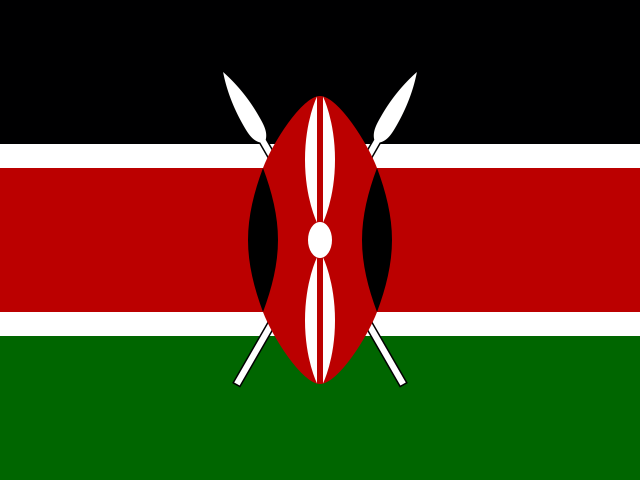
Kenya: the mobile-money pioneer that became a global stablecoin power
Kenya has done this before. Two decades ago, while much of the world still assumed you needed a bank branch to move money, Kenya leapfrogged the entire model with M-Pesa and put a working payment system in the hands of tens of millions of people through their phones. It did not wait for the formal system to modernise. It built around it.
Kenya is now doing the same thing a second time — and the tool this time is the dollar stablecoin.
The scale
Kenya has quietly become one of the largest stablecoin markets in the world. By transaction volume it ranks among the global leaders, not far behind the likes of Nigeria and Vietnam. In the twelve months to mid-2024, Kenyans sent and received roughly three-and-a-third billion dollars in stablecoin transactions, making the country one of the largest recipients of stablecoin value on the continent.
This is not speculative trading. The dominant use cases are the ones this series returns to again and again: protecting savings from a depreciating shilling, receiving remittances from a large diaspora, and settling cross-border payments without paying the punishing fees of the traditional channels — fees that across Sub-Saharan Africa still average well over eight per cent, nearly three times the level the United Nations sets as a target.
The piece Kenya already has: the last mile
Here is what makes Kenya structurally different from most markets in this series. The hardest part of any settlement system is the last mile — getting value out of the digital layer and into something an ordinary person or business can actually spend. In most countries that off-ramp has to be built. In Kenya it already exists, and it is called mobile money.
Local platforms now let stablecoins be converted directly into M-Pesa and other mobile wallets. Someone can receive a dollar stablecoin from abroad and cash it out into the same phone-based money they already use for daily life, in minutes. That bridge — stablecoin to mobile money — is the connective tissue a market needs to move from grassroots adoption to genuine infrastructure, and Kenya has it at national scale already.
The regulation is arriving
Kenya is also moving from tolerance to rules. In 2025 its parliament passed a Virtual Asset Service Providers Act, a sweeping law to regulate stablecoin and digital-asset firms, with the Central Bank of Kenya assigned to oversee the licensing of stablecoin issuers. Like Ghana, Kenya chose to legislate rather than prohibit — a recognition that adoption is already mainstream and that the sensible path is to supervise it, not pretend it away.
For a treasury-infrastructure business, that combination is close to ideal: deep existing adoption, a national off-ramp through mobile money, and a regulator now building the legal framework to operate inside.
My read
Kenya is the most infrastructure-ready market in Sub-Saharan Africa. Where Nigeria has the largest raw demand and the most dramatic currency story, Kenya has something quieter and arguably more valuable for building real settlement corridors: the rails are already in the ground. The phones, the mobile-money habit, the conversion services, and now the regulation are all in place.
When people ask where the regulated future of African digital settlement is most likely to take shape first, Kenya is one of the strongest answers. It leapfrogged the bank branch once. It is leapfrogging again — and this time the destination is a dollar that holds its value and settles in seconds.
Corridor profiles are market analysis. They describe where cross-border value moves and why — not where Global Digital Treasury provides services. Servable coverage is confirmed corridor by corridor at the point of engagement, and is narrower than the set of markets analysed here.