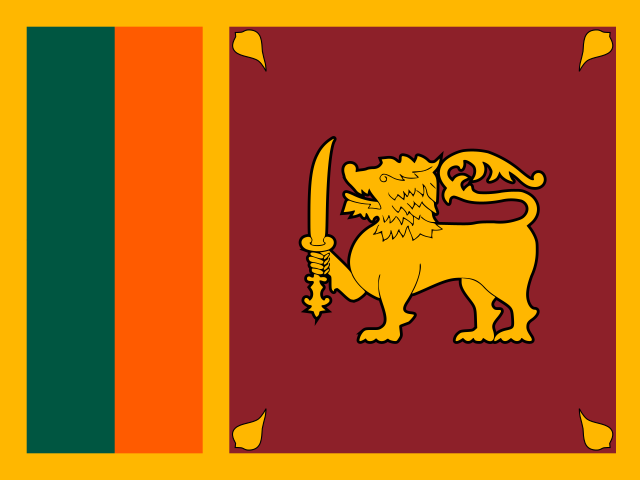
Sri Lanka: how a sovereign default taught a nation to settle in USDT
Some markets adopt stablecoins gradually. Sri Lanka adopted them in a crisis. When the country defaulted on its sovereign debt in 2022 and its banking system ran out of foreign currency, ordinary Sri Lankans and the migrant workers supporting them did what people always do when the formal system fails: they found another way to hold and move dollars. That way was USDT.
Sri Lanka is a smaller market than most in this series, but it is one of the clearest case studies of how quickly stablecoin adoption takes hold when a currency and a banking system break at the same time.
The crisis that started it
In 2022, Sri Lanka suffered one of the most severe economic collapses of any middle-income country in recent memory. The rupee depreciated by nearly 45 percent. Inflation peaked above 54 percent. And the country defaulted on its external debt for the first time since independence. The banking system simply ran short of dollars, unable to fund imports of fuel, food, and medicine.
Official remittances — a lifeline for an economy with more than three million citizens working abroad — collapsed to a twelve-year low of around $3.78 billion. The reason was telling: migrant workers stopped sending money through formal banking channels, because those channels could not reliably deliver value, and shifted instead to USDT, which could. A dollar-pegged stablecoin held its worth while the rupee cratered, and it moved across borders when the banks could not.
The recovery — and what stuck
Sri Lanka has since stabilised under an IMF programme. Inflation has fallen sharply, growth has returned, and reserves have rebuilt to around $6 billion. Remittances recovered strongly, reaching a record of roughly $8 billion in 2025.
But the behaviour learned in the crisis did not reverse. A growing share of those remittance and savings flows now moves through USDT and peer-to-peer networks rather than traditional banking. The number of digital-asset users has passed one million and is climbing. Telegram and WhatsApp OTC groups — informal over-the-counter desks operating in the regulatory grey space — continue to expand. USDT has effectively become an unofficial parallel-dollar channel, used both to preserve value and to move it across borders.
That is the durable lesson of crises: they teach behaviours that outlast the emergency. Sri Lankans learned that a digital dollar is more reliable than their banking system in a pinch, and that lesson did not un-learn itself when the pinch eased.
The framework now forming
Until recently, virtual assets in Sri Lanka existed in a complete legal vacuum — no framework, no monitoring, no regulation, which predictably attracted scams alongside legitimate use. That is now changing, and quickly.
Since late 2025, the Financial Intelligence Unit has launched a mandatory survey of all virtual-asset service providers operating in the country — the first formal step toward identifying and regulating the sector. The roadmap that follows includes registering these providers, classifying virtual assets as a distinct legal category, and implementing anti-money-laundering requirements aligned with international standards, including the FATF travel rule. There is real urgency behind this: international evaluators have been assessing Sri Lanka's compliance, with the country keen to avoid the economic consequences of being grey-listed for weak financial controls.
In other words, Sri Lanka is moving from vacuum to framework — driven not by enthusiasm for the technology, but by the need to bring large, existing, informal flows under proper supervision.
What it means for treasury infrastructure
Sri Lanka shows the demand side and the regulatory side moving in sequence. The demand arrived first, forged in crisis. The framework is arriving second, forced by the scale of the informal flows and by international compliance pressure. That sequence — demand, then regulation — is precisely the environment in which a compliant, regulated orchestration and settlement layer becomes valuable.
The opportunity here is modest in absolute size but instructive in shape: an $8 billion remittance economy with proven, durable USDT adoption, a large overseas workforce, and a government now building the AML and licensing scaffolding that a serious operator needs in order to serve those flows in the open rather than the grey market.
My read
Sri Lanka is a smaller, higher-risk frontier market still recovering from a genuine financial collapse, and I would size any opportunity there accordingly. The framework is early and the economy remains fragile.
But the case study is valuable well beyond Sri Lanka itself. It demonstrates, in compressed and vivid form, the whole thesis: that when currencies and banks fail, people settle in stablecoins; that the behaviour persists long after the crisis; and that regulation eventually follows the flows rather than leading them. Watch Sri Lanka not for its size, but for what it teaches about every fragile economy that has not yet had its crisis.
Corridor profiles are market analysis. They describe where cross-border value moves and why — not where Global Digital Treasury provides services. Servable coverage is confirmed corridor by corridor at the point of engagement, and is narrower than the set of markets analysed here.