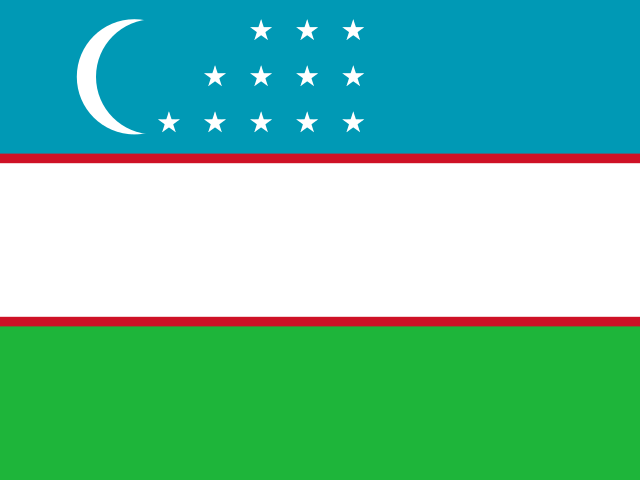
Uzbekistan: a $19 billion remittance economy that just made digital-dollar payments legal
Most people in Western finance could not place Uzbekistan on a map, let alone describe its payments system. That is exactly why it is worth your attention. Some of the most interesting developments in this market are happening in countries that rarely make the front page.
This note is the first of a few I will write on specific markets. I am starting with Uzbekistan because it shows, in one country, the whole pattern this series has been describing: a real economic dependence on cross-border flows, a structural vulnerability in how those flows move today, and a government that has chosen to meet the problem head-on rather than pretend it away.
Why Uzbekistan at all
A little orientation. Uzbekistan is the most populous country in Central Asia, with around 37 million people, a young and growing workforce, and a government that since 2017 has been steadily dismantling decades of economic isolation. That year it floated its currency, the som, and abolished the worst of its currency controls — a genuine break from the closed, Soviet-legacy system that came before.
It is, in other words, a reforming economy actively trying to connect itself to the rest of the world. And the single largest financial flow connecting it today is remittances.
The remittance economy — and its single point of failure
The numbers are striking. Remittances into Uzbekistan reached roughly $18.9 billion in 2025, having tripled in five years. For an economy of its size, that is not a side flow. It is a pillar of household income and national stability.
Now the vulnerability. Close to 78 percent of those transfers — around $15 billion — come from a single country: Russia, where millions of Uzbek citizens work as labour migrants. The flow rises and falls with the Russian ruble and with conditions for migrants there.
Stop and consider what that means for risk. A nation's most important income stream depends on one currency, one labour market, and one increasingly complicated banking relationship. When that much of a country's inflows ride on a single, sanctions-affected corridor, the case for diversifying how value moves — and through which rails — stops being theoretical. It becomes a matter of national resilience.
That is the pain. It is also the opportunity.
The reform instinct
What makes Uzbekistan different from most markets with this profile is the response. Rather than tightening controls, the government has leaned the other way — toward openness, regulation, and modern infrastructure. The 2017 currency float was the first signal. What came next is the part that should make any treasury-infrastructure investor sit up.
The standout move: stablecoins as a legal means of payment
From 1 January 2026, Uzbekistan began recognising stablecoins as a legal means of payment.
Let me be precise, because the headlines overstate it. This is not "stablecoins are now the national currency." It is a structured, supervised framework: stablecoins are permitted as a means of payment inside a regulatory sandbox run jointly by the National Agency of Perspective Projects — the body that licenses digital-asset businesses in Uzbekistan — and the Central Bank. Participants are vetted, given a defined window to operate, and required to meet anti-money-laundering standards aligned with international FATF guidelines. The same framework opens the door to tokenised securities such as stocks and bonds.
Read that again with a finance eye. A sovereign state has built a regulated, AML-compliant on-ramp for digital-dollar settlement, supervised by its central bank. This is not a grey market being tolerated. It is a government building the rails deliberately, with guardrails. For anyone whose business is regulated treasury orchestration, that is close to an ideal operating environment — clarity, oversight, and official welcome, in one of the markets that needs better settlement most.
A Central Asian corridor is forming
Uzbekistan is not acting alone, and this is the part I find most interesting. Kyrgyzstan launched a som-pegged stablecoin in late 2025. Kazakhstan — the subject of my next note — is piloting a tenge-backed equivalent. Three neighbouring states are moving toward regulated digital settlement at the same time.
That is how a regional corridor is born. When multiple connected economies adopt compatible rails within a short window, the cost of moving value between them falls, and a new settlement geography quietly takes shape. Central Asia, long treated as a financial periphery, may be assembling one of the more advanced regulated-stablecoin regions in the world.
What it means for treasury infrastructure
The lesson of Uzbekistan is that our thesis is not confined to the obvious large markets. The same forces — cross-border dependence, currency concentration, banking fragility, and a government reaching for better infrastructure — appear in places most investors overlook.
A market like this rewards an orchestration layer rather than another local provider. A corporate or a financial institution operating across Uzbekistan, its neighbours, and its trading partners does not want five separate relationships and five compliance regimes. It wants one interface, one set of controls, and visibility across all of it. That is precisely the layer that does not yet exist here, in a region that has just made the underlying rails legal and supervised.
My read
I am not suggesting Uzbekistan is a finished opportunity. It is a frontier market with real political and currency risk, a heavy dependence on a single difficult corridor, and frameworks that are new and still being tested.
But it is doing something most economies its size are not: building the regulated foundations for digital settlement before the demand fully arrives, rather than scrambling after it. When a government supervises the rails itself, the question for the rest of us shifts from "is this allowed" to "who will build the layer that makes it usable." That is a far better question to be answering.
Keep an eye on Central Asia. The interesting work in this market is not only happening where you would expect it.
Corridor profiles are market analysis. They describe where cross-border value moves and why — not where Global Digital Treasury provides services. Servable coverage is confirmed corridor by corridor at the point of engagement, and is narrower than the set of markets analysed here.